Turkish Makam
Makam Sabâ on guitar
Also written Sabâ Makamı, Saba
A Sabâ tetrachord on Dügâh joined to the Zirgüleli Hicaz scale on Çargâh. It is a compound makam that does not repeat at the octave: its upper karar is Şehnaz, a little under the octave of Dügâh.
- Karar: Dügâh (A)
- Güçlü: Çargâh (C)
- Seyir: çıkıcı
This scale does not repeat at the octave. Climbing from the karar it runs A B↓ C D♭ E↓ F G A♭↑ B↓ C.
Karar Güçlü Between the frets Tap any note to hear it at its exact pitch.
The notes, one by one
Intervals are counted in Holdrian commas, 53 to the octave (about 22.6 cents each), as in Arel-Ezgi-Uzdilek theory. Performance practice differs from the theory in places. Pitches are given in cents above the karar; a fretted semitone is 100 cents.
| # | Note | Perde | Above the karar | On a standard guitar |
|---|---|---|---|---|
| 1 | A Karar | Dügâh | 0.0¢ | On the fret |
| 2 | B −19¢ | Segâh | 181.1¢ | Nearest fret; the real pitch is 19¢ lower |
| 3 | C Güçlü | Çargâh | 294.3¢ | On the fret |
| 4 | D♭ | Hicaz | 407.5¢ | On the fret |
| 5 | E −21¢ | Dik Hisar | 679.2¢ | Fret E, bend up 79¢ |
| 6 | F | Acem | 792.5¢ | On the fret |
| 7 | G | Gerdaniye | 996.2¢ | On the fret |
| 8 | A♭ +9¢ | Şehnaz | 1109.4¢ | Nearest fret; the real pitch is 9¢ higher |
Çeşniler
A makam is built from small units of three to five notes, each with its own colour. These are the units of Makam Sabâ.
-
Sabâ dörtlüsü
On Dügâh (A), 4 notes
A · B −19¢ · C · D♭
-
Hicaz beşlisi
On Çargâh (C), 5 notes
C · D♭ · E −21¢ · F · G
-
Hicaz dörtlüsü
On Gerdaniye (G), 4 notes
G · A♭ +9¢ · B −19¢ · C
Seyir
Ascending (çıkıcı), at times ascending then descending: it starts around the karar or the güçlü, and turns around Çargâh.
- Begins around the karar, Dügâh, or the güçlü, Çargâh.
- With Çargâh as its axis, moves freely through the units of the scale and makes a half cadence on Çargâh with the Zirgüleli Hicaz flavour.
- Shows suspended cadences along the way.
- Closes on Dügâh with the Sabâ flavour.
Asma kararlar
- Gerdaniye: Hicaz
- Acem: Nikriz
- Dik Hisar: Hüzzam or Segâh
Example phrase
Rises through the Sabâ tetrachord to rest on the güçlü, Çargâh, shows the Hicaz flavour above it up to Acem, falls back to Çargâh, and closes on Dügâh from Rast, the leading tone below.
A short outline written for Fretwise that follows the seyir above. It is not a quotation from the repertoire. Press “Play the phrase” on the neck to hear it.
Sources
- Sabâ (TDV İslâm Ansiklopedisi, vol. 35) · İsmail Hakkı Özkan · 2008
Tuning convention: Arel-Ezgi-Uzdilek. Intervals are written as in the source; practice varies by region and player.
How to play maqam on a standard guitar: when to bend, when to use the nearest fret
Fretwise · Free on iPhone & Android
Practise Makam Sabâ anywhere, even offline.
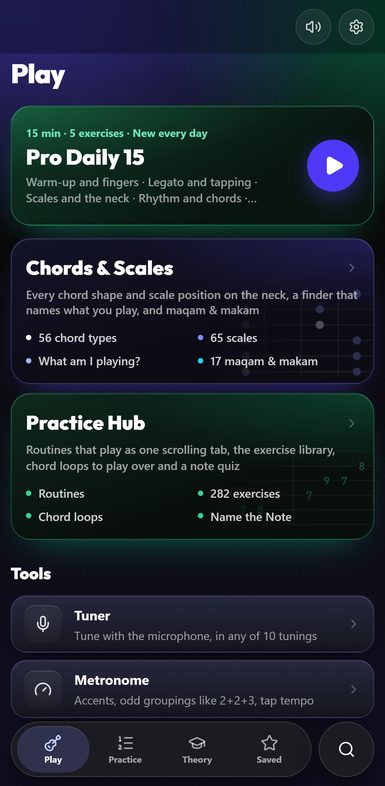
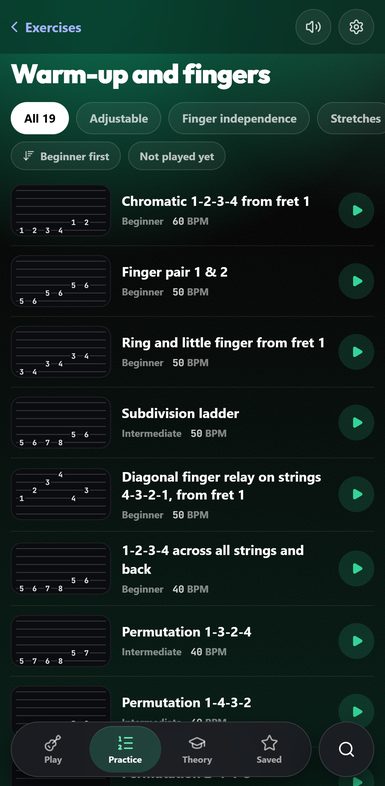
This page is a small slice of Fretwise. The app adds practice: exercises that play as tab, a new routine every day, and the tools to tune and keep time. On iPhone, iPad and Android, no sign-up.
Free
- 65 scales and 56 chord types in every key, with CAGED shapes
- A tuner with 10 tunings and a metronome from 30 to 260 BPM
- A new Daily 15 routine every day, plus free exercises
- Maqam & makam between the frets, and the Name the Note quiz
One purchase
- 282 exercises that play as tab, and routines with a speed trainer
- Chord & Scale Finder: tap the neck, get the name
- Theory Lab and the Progression Builder with 51 genre loops
- No subscription, ads removed